
Dental Implants Lansdale PA
Implant Teeth In Lansdale
Losing a tooth affects more than the appearance of your smile. Teeth allow us to chew comfortably, speak clearly, maintain the position of neighboring teeth, and support the bone and soft tissues of the jaws.
Dental implants are designed to replace missing teeth in a way that closely resembles natural teeth in both form and function. An implant acts as a replacement for the root of a missing tooth and provides support for a crown, bridge, or larger implant-supported restoration.
At Buxmont Prosthodontics & Restorative Dentistry in Lansdale, implant treatment is planned with the final result in mind from the beginning. Our prosthodontists consider not simply where an implant can be placed, but where it should be positioned to create a restoration that looks natural, functions comfortably, is cleansable, and can be maintained over the long term.
Reclaim the Confidence to Smile Again!
Trust your care to our expert prothodontic & restorative dental team.
Overview: Dental Implants
A dental implant is a small biocompatible implant, most commonly made from titanium, that is placed into the jawbone to replace the root portion of a missing tooth.
After the implant is placed, the surrounding bone heals around its surface through a biological process called osseointegration. Once the implant is stable, it can support a restoration such as:
- A crown replacing one tooth
- An implant-supported bridge replacing several teeth
- An implant-supported removable prosthesis
- A fixed full-arch restoration replacing an entire set of teeth
A dental implant therefore represents only one part of the treatment. The tooth or teeth that you see and chew with are prosthetic restorations designed and attached to the implants.
Patient Benefits: Dental Implants
The goal of implant treatment is not simply to fill an empty space. It is to restore the appearance, comfort, function, and stability that were lost with the natural tooth.
Feel and Function More Like Natural Teeth
Because an implant-supported tooth is anchored to the jaw rather than resting on the gums, it can provide excellent stability during chewing and speaking.
Patients are often able to eat a broader range of foods with greater confidence than they could with a removable prosthesis.
Restore Chewing Ability
Missing teeth—or removable teeth that move during function—can make certain foods difficult to chew.
A properly designed implant restoration can provide a stable chewing surface and distribute biting forces in a way that more closely resembles natural dentition.
Preserve Jawbone
The bone surrounding a natural tooth is maintained partly by the forces transmitted through its root. After a tooth is removed, the surrounding ridge naturally begins to change in shape and volume.
Dental implants transfer functional forces into the jawbone and can help maintain bone around the implant site. They do not completely eliminate the normal changes that occur after tooth loss, but they can provide an important advantage compared with tooth-replacement options that simply rest above the bone.
Avoid Preparing Healthy Adjacent Teeth
A conventional dental bridge usually requires the teeth on either side of the missing tooth to support the restoration.
For a patient whose neighboring teeth are healthy and largely unrestored, an implant may allow us to replace the missing tooth without removing healthy tooth structure from those adjacent teeth.
Confidence and Appearance
A missing tooth—particularly in the front of the mouth—can affect how a person smiles, speaks, eats, and interacts socially.
Careful implant treatment considers much more than simply replacing the tooth. The position of the implant, gum contours, tooth proportions, color, bite, and relationship to the surrounding teeth all influence whether the final result appears natural.
Long-Term Treatment
Dental implants have been used successfully for decades and can provide long-lasting treatment when they are properly planned, restored, cleaned, and maintained.
They are not, however, immune to problems. Implant restorations can wear, loosen, fracture, or require repair over time, and inflammation or bone loss can develop around implants if the surrounding tissues are not kept healthy. Regular professional maintenance and good home care remain essential.
Patient Experience: Dental Implants
Successful implant dentistry begins before the implant is ever placed.
One of the most important principles in modern implant treatment is restoratively driven planning. In other words, we first determine where the replacement tooth should be located for ideal appearance, function, and cleansability. We then determine whether an implant can be predictably positioned to support that tooth.
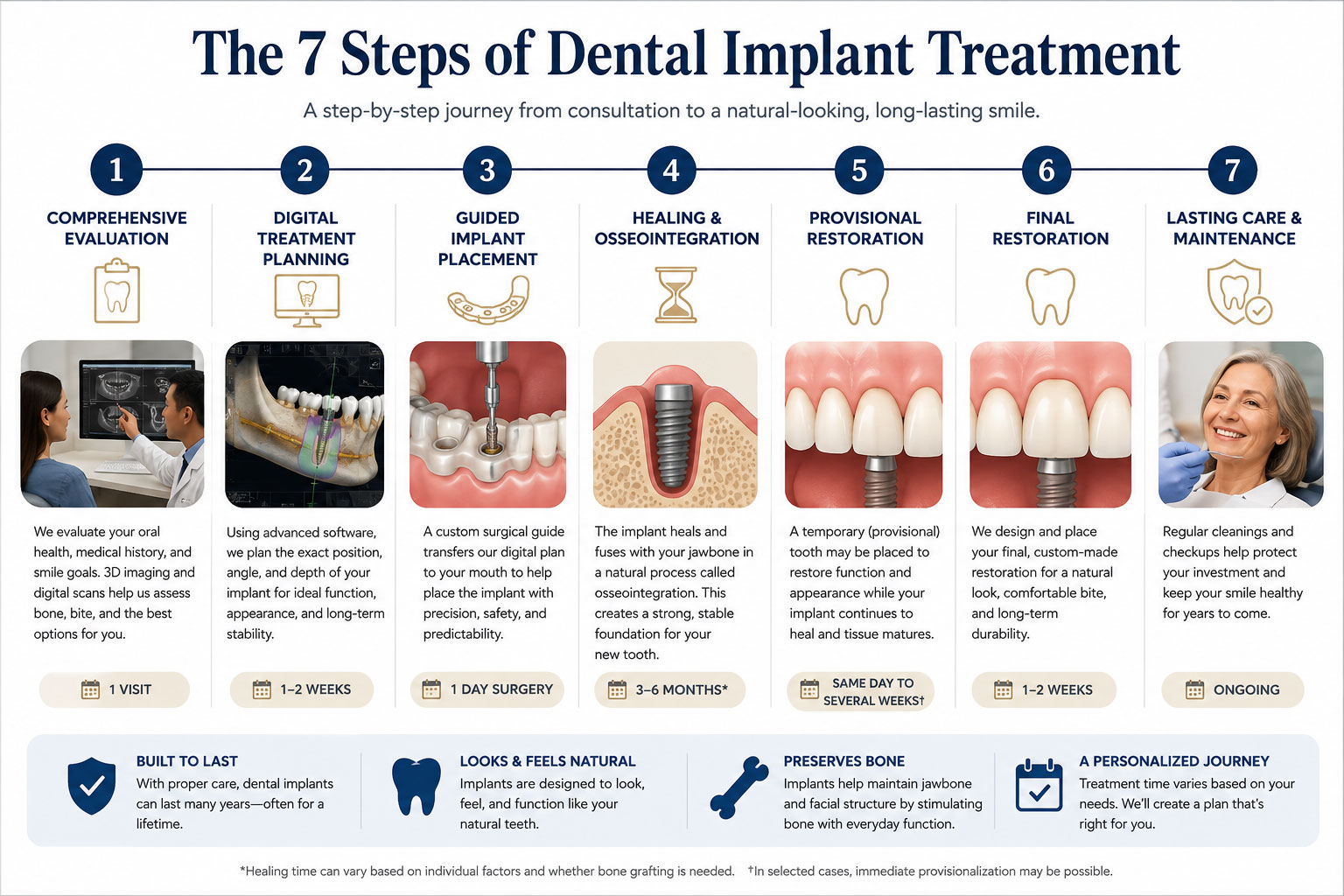
- Tooth shape and appearance
- Speech
- Bite and chewing
- Gum contours
- Cleansability
- The patient’s comfort with the proposed final result
Recovery After Dental Implant Surgery
Most patients can return relatively quickly to normal daily activities after uncomplicated implant surgery, although more extensive procedures can require additional recovery.
We provide individualized postoperative instructions based on the procedure performed. Pain is commonly managed with appropriate over-the-counter or prescription medication when necessary. Antibiotics may be prescribed when clinically indicated rather than being required for every patient.
A softer diet is typically recommended initially so that unnecessary pressure is not placed on the surgical site during early healing.
Swelling often develops during the first few days and then gradually improves. The gum tissue generally heals much sooner than the implant itself; integration of the implant with the underlying bone continues for weeks to months.
Treatment Options: Compared With Dental Implants
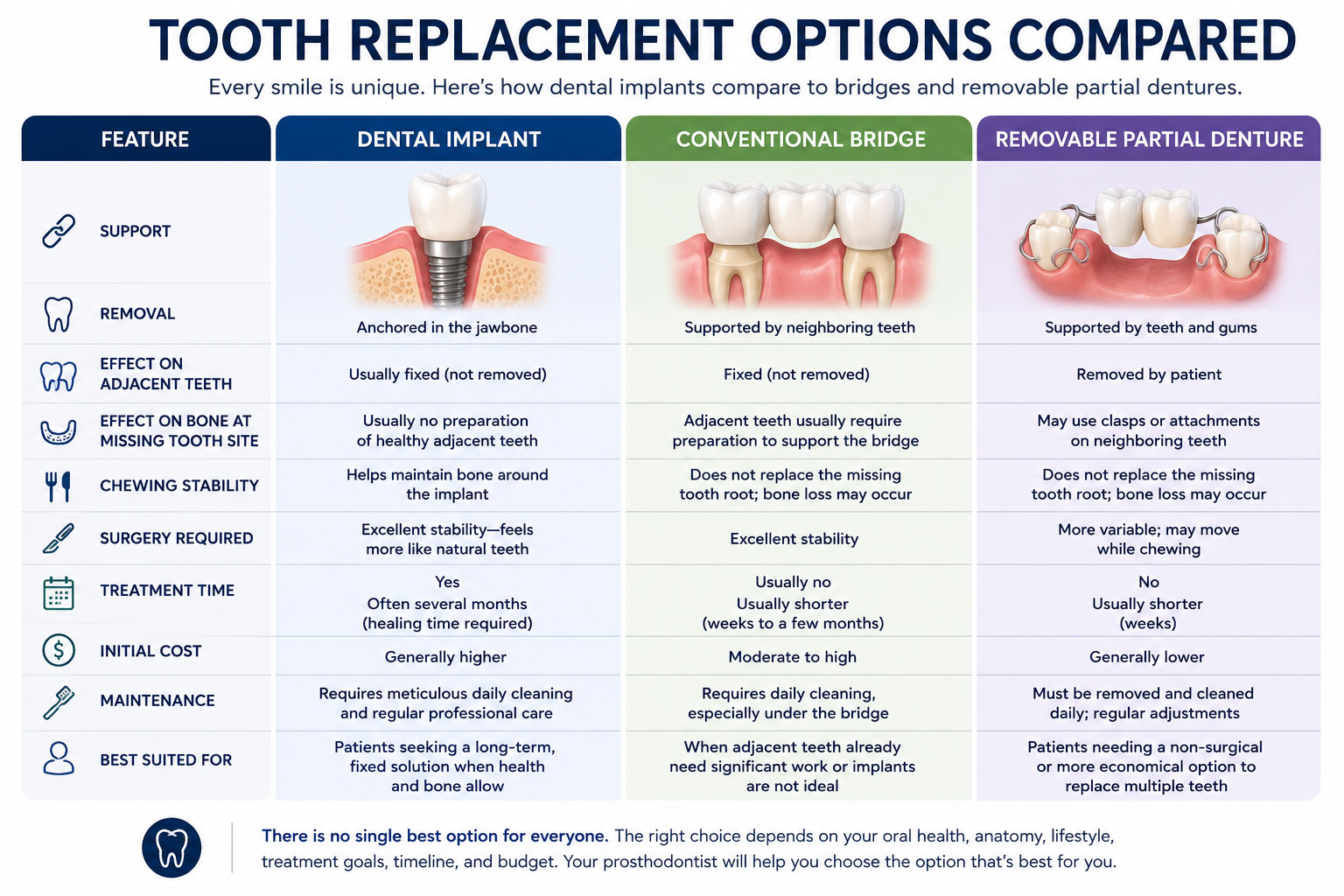
There is no single tooth-replacement option that is best for every patient. Dental implants, conventional bridges, and removable partial dentures can all be appropriate treatments depending on the condition of the remaining teeth, amount of available bone, medical considerations, treatment time, cost, and patient priorities.
Dental Implant vs. Dental Bridge
A traditional fixed bridge can be an excellent restoration and may sometimes be preferable to an implant.
For example, if the teeth next to a missing tooth already require crowns because of large restorations, fractures, or other structural problems, using those teeth to support a bridge may be very reasonable.
If the neighboring teeth are healthy and minimally restored, however, an implant has an important advantage: the missing tooth can often be replaced without preparing the adjacent teeth.
Implants also replace support at the level of the jawbone, whereas a traditional bridge replaces only the portion of the tooth above the gum. The American Academy of Periodontology notes that implant-supported replacement can help preserve bone at missing-tooth sites and avoids some of the issues associated with preparing bridge abutment teeth.
Dental Implant vs. Removable Partial Denture
A removable partial denture can replace several missing teeth without surgery and typically involves a lower initial investment than implant therapy.
Its main tradeoff is that it is removable and derives support from the remaining teeth and gums.
Some patients experience movement while chewing, pressure on the gums, visible clasps, or difficulty eating certain foods.
Implants may be used either to eliminate the need for a removable partial denture or, in certain situations, to provide additional support and stability for one.
The Prosthodontist Advantage For Dental Implants
Implant dentistry is both a surgical and a restorative discipline.
The ultimate goal is not simply to place an implant into bone. It is to create a tooth or set of teeth that functions comfortably, looks natural, fits the patient’s bite, and can be maintained over time.
A prosthodontist is a dentist who completes additional advanced specialty training in restoring and replacing teeth, including dental implants, crowns, bridges, dentures, esthetics, occlusion, and complex rehabilitation.
At Buxmont Prosthodontics & Restorative Dentistry, Dr. Bruce Chernow and Dr. Ron Wang bring specialty training in prosthodontics to implant treatment. Dr. Wang completed a three-year prosthodontic residency with training in implant dentistry and complex rehabilitation, while Dr. Chernow has practiced prosthodontics for decades and has incorporated digital design and in-house manufacturing into the practice’s restorative workflow.
Our treatment philosophy is restoration first: we determine the ideal tooth position, appearance, function, and bite and then plan implant placement around that desired result.
Combined with three-dimensional imaging and our on-site digital dental laboratory, this approach allows the surgical, restorative, and laboratory phases of treatment to be closely coordinated.
Make Your Smile Complete!
Contact our team to schedule your dental implants consultation
Frequently Asked Questions About Dental Implants
How long does the dental implant process take?
Treatment time varies considerably. Straightforward cases may progress from implant placement to the final restoration over several months. Bone grafting, extractions, complex reconstruction, or treatment involving multiple implants may require a longer timeline.
We provide a personalized sequence and estimated treatment timeline after evaluating your individual situation.
What Does Dental Implant Surgery Feel Like?
A common concern is whether dental implant placement is painful.
During surgery, the area is thoroughly anesthetized with local anesthetic. Patients generally feel pressure and vibration rather than sharp pain. Sedation may also be available when appropriate.
After the procedure, some soreness, swelling, bruising, or tenderness is normal. The amount varies considerably depending on whether one implant or several implants were placed and whether procedures such as extractions or bone grafting were performed at the same appointment.
Many patients are pleasantly surprised by their recovery after straightforward implant placement.
Am I a Candidate for Dental Implants?
Many adults who have lost one or more teeth can be considered for implant treatment, but candidacy depends on much more than age.
Important considerations include the amount and quality of available bone, gum health, condition of the remaining teeth, bite forces, medical health, medications, smoking or nicotine exposure, oral hygiene, and the type of restoration being planned.
Having experienced bone loss does not automatically mean that implants are impossible. Bone grafting or alternative treatment strategies may allow implant treatment in some patients with inadequate bone.
The most useful way to determine your options is through a comprehensive examination and three-dimensional evaluation.
Are Dental Implants Permanent?
Dental implants are intended to provide long-term tooth replacement, and many function successfully for many years.
However, describing implants as “permanent” can be misleading.
The implant itself, the surrounding bone and gums, and the prosthetic tooth attached to it are different components. Over a lifetime, an implant restoration may require maintenance, repair, or replacement even when the implant remains healthy.
Just as natural teeth require ongoing care, implants require regular cleaning, professional evaluation, and monitoring of the surrounding tissues. Full-arch implant restorations in particular require structured professional maintenance based on the patient’s individual risk factors.
Can I have a temporary tooth while the implant heals?
In many situations, yes.
Depending on the implant’s location and stability, a temporary removable or fixed restoration can often be provided during healing. In selected cases, a provisional tooth can be attached to the implant itself.
The safest provisional option depends on the stability of the implant and the forces that will be placed on it while the bone heals.
Do dental implants get cavities?
The implant and implant crown cannot develop tooth decay in the same manner as a natural tooth.
The gums and bone surrounding an implant can still develop inflammation and disease, however. Implant maintenance and good plaque control remain extremely important.
What happens if I do not have enough bone for an implant?
Insufficient bone does not necessarily rule out implant treatment. Depending on the location and severity of the deficiency, bone grafting, ridge augmentation, sinus augmentation, alternative implant positions, or another restorative approach may be considered.
Is everyone a candidate for dental implants?
No. Although implants are appropriate for many patients, uncontrolled disease, inadequate anatomy, poor oral hygiene, certain medications or medical conditions, heavy smoking or nicotine use, and other factors may increase treatment risk.
Sometimes a bridge or removable prosthesis is the more appropriate treatment.
How do I know whether an implant, bridge, or partial denture is best for me?
The decision should be based on the condition of the neighboring teeth, available bone, gum health, bite, medical history, esthetic requirements, treatment time, cost, and your priorities.
Our role is to explain the advantages and disadvantages of each reasonable treatment—not simply to recommend an implant because an implant can be placed.
How much do dental implants cost?
The cost of dental implant treatment depends on the complexity of your individual case and the type of restoration being provided.
A single implant-supported tooth involves several components, including the implant itself and the final restoration. Additional procedures such as tooth extraction, bone grafting, temporary restorations, or other surgical treatment may also affect the total cost. Replacing several teeth or an entire arch requires a different treatment plan and fee structure.
Because of these variables, it can be misleading to quote a single price for “a dental implant” without first determining what treatment you actually need.
After your evaluation, we will review the recommended treatment, alternatives, anticipated fees, and available financial options with you so that you can make an informed decision before proceeding.
Considering Dental Implants?
If you are missing a tooth, several teeth, or are facing the loss of teeth, the first step is understanding your options.
At Buxmont Prosthodontics & Restorative Dentistry in Lansdale, PA, we evaluate implant treatment from both the surgical and restorative perspective and develop an individualized plan based on your anatomy, health, function, esthetic goals, and long-term prognosis.
Schedule a consultation to learn whether dental implants are appropriate for you and how they compare with your other tooth-replacement options.